Species Details
Euxoa campestris
University of Alberta E.H. Strickland Entomological Museum Read more about this collection »
Common NameFlat Dart
SeasonalityAdults have been collected in Alberta from mid July through early September.
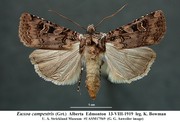
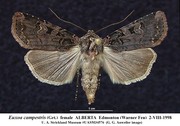
IdentificationA medium-size (3.0-3.4 cm wingspan) dark brown moth with black markings. The prothoracic collar has several narrow dark and light bands. The forewings are dark chocolate or blackish brown., with doubled black basal and antemedian lines and a single, scalloped PM line. The area proximal to and between the orbicular and reniform is black, and the reniform is incompletely lined inside with yellow-brown scales. The subterminal line is obscure, incompletely lined distally with contrasting yellow-brown scales. The terminal area and fringe are dark brown. Most of the markings stand out poorly against the dark ground. The hindwings are sooty brown, darker toward the margin and in females, with a dark discal bar and brown fringes. Very similar to dark brown specimens of E. declarata, which are slightly larger and paler. The hindwings of declarata males in particular are lighter and have dirty white or very light brown fringes. There are also minor differences in the genitalia (see Lafontaine, 1987)
Euxoa campestris belongs to the subgenus Euxoa, characterized mainly by the shape of the vesica in males. Keys to the subgenera and species are provided in Lafontaine, 1987.
Scientific Name
Euxoa campestris
Common Name
Flat Dart
Habitat
Woodland, meadows and cultivated areas.
Seasonality
Adults have been collected in Alberta from mid July through early September.
Identification
A medium-size (3.0-3.4 cm wingspan) dark brown moth with black markings. The prothoracic collar has several narrow dark and light bands. The forewings are dark chocolate or blackish brown., with doubled black basal…
A medium-size (3.0-3.4 cm wingspan) dark brown moth with black markings. The prothoracic collar has several narrow dark and light bands. The forewings are dark chocolate or blackish brown., with doubled black basal and antemedian lines and a single, scalloped PM line. The area proximal to and between the orbicular and reniform is black, and the reniform is incompletely lined inside with yellow-brown scales. The subterminal line is obscure, incompletely lined distally with contrasting yellow-brown scales. The terminal area and fringe are dark brown. Most of the markings stand out poorly against the dark ground. The hindwings are sooty brown, darker toward the margin and in females, with a dark discal bar and brown fringes. Very similar to dark brown specimens of E. declarata, which are slightly larger and paler. The hindwings of declarata males in particular are lighter and have dirty white or very light brown fringes. There are also minor differences in the genitalia (see Lafontaine, 1987)
Euxoa campestris belongs to the subgenus Euxoa, characterized mainly by the shape of the vesica in males. Keys to the subgenera and species are provided in Lafontaine, 1987.
Life History
Poorly known. There is a single annual brood. The adults are attracted to both light and sugar baits. The larvae, which are known only from lab-reared material, have little or no summer aestivation.
Conservation
A fairly common, widespread species; no concerns.
Diet Info
Unknown. Related species are general feeders on a variety of low-growing plants.
Range
From Newfoundland west across the boreal forest to Alaska, south in the east to northern New England and southern Canada west to southern British Columbia; south in the mountains to New Mexico, Arizona and Utah. In…
From Newfoundland west across the boreal forest to Alaska, south in the east to northern New England and southern Canada west to southern British Columbia; south in the mountains to New Mexico, Arizona and Utah. In Alberta, it has been collected mainly in the southern boreal forest and parklands regions, from the Red Deer River (Tolman Bridge) north to Fort McMurray; apparently rare or absent in the foothills and mountains.

Citation
Page Citation for Euxoa campestris
Page Citation
"Species Details - Euxoa campestris, University of Alberta E.H. Strickland Entomological Museum." University of Alberta Museums Search Site, https://search.museums.ualberta.ca/g/2-3856. Accessed 19 Aug. 2025.
References
Author
Lafontaine, J. Donald
Title
Noctuoidea : Noctuidae (part)
Publication Date
1987
Pages
237
Specimen Information
There are 139 specimens of this Species.
BIRD8743 - Euxoa campestris
University of Alberta E.H. Strickland Entomological Museum
Place CollectedCanada: Alberta, Dry Island Buffalo Jump Provincial Park
Collected ByBird, C. D.
Date Collected2002-09-10
BIRD8744 - Euxoa campestris
University of Alberta E.H. Strickland Entomological Museum
Place CollectedCanada: Alberta, Dry Island Buffalo Jump Provincial Park
Collected ByBird, C. D.
Date Collected2002-09-10
BIRD8745 - Euxoa campestris
University of Alberta E.H. Strickland Entomological Museum
Place CollectedCanada: Alberta, Erskine
Collected ByBird, C. D.
Date Collected2002-09-18
BIRD8746 - Euxoa campestris
University of Alberta E.H. Strickland Entomological Museum
Place CollectedCanada: Alberta, Erskine
Collected ByBird, C. D.
Date Collected2002-09-18
BIRD8747 - Euxoa campestris
University of Alberta E.H. Strickland Entomological Museum
Place CollectedCanada: Alberta, Erskine
Collected ByBird, C. D.
Date Collected2003-08-15
BIRD8748 - Euxoa campestris
University of Alberta E.H. Strickland Entomological Museum
Place CollectedCanada: Alberta, Erskine
Collected ByBird, C. D.
Date Collected2003-08-21
BIRD8749 - Euxoa campestris
University of Alberta E.H. Strickland Entomological Museum
Place CollectedCanada: Alberta, Erskine
Collected ByBird, C. D.
Date Collected2004-08-06
BIRD8750 - Euxoa campestris
University of Alberta E.H. Strickland Entomological Museum
Place CollectedCanada: Alberta, Erskine
Collected ByBird, C. D.
Date Collected2004-08-18
BIRD8751 - Euxoa campestris
University of Alberta E.H. Strickland Entomological Museum
Place CollectedCanada: Alberta, Erskine
Collected ByBird, C. D.
Date Collected2004-08-18
BIRD8752 - Euxoa campestris
University of Alberta E.H. Strickland Entomological Museum
Place CollectedCanada: Alberta, Erskine
Collected ByBird, C. D.
Date Collected2004-08-18
BIRD8753 - Euxoa campestris
University of Alberta E.H. Strickland Entomological Museum
Place CollectedCanada: Alberta, Erskine
Collected ByBird, C. D.
Date Collected2004-08-18
BIRD8754 - Euxoa campestris
University of Alberta E.H. Strickland Entomological Museum
Place CollectedCanada: Alberta, Buffalo Lake Conservation Area
Collected ByBird, C. D.
Date Collected2004-08-30
BIRD8755 - Euxoa campestris
University of Alberta E.H. Strickland Entomological Museum
Place CollectedCanada: Alberta, Erskine
Collected ByBird, C. D.
Date Collected2004-09-01
BIRD8756 - Euxoa campestris
University of Alberta E.H. Strickland Entomological Museum
Place CollectedCanada: Alberta, Rochon Sands Provincial Park
Collected ByBird, C. D.
Date Collected2004-09-11
BIRD8757 - Euxoa campestris
University of Alberta E.H. Strickland Entomological Museum
Place CollectedCanada: Alberta, Erskine
Collected ByBird, C. D.
Date Collected2004-09-21
BIRD15975 - Euxoa campestris
University of Alberta E.H. Strickland Entomological Museum
Place CollectedCanada: Alberta, Dry Island Buffalo Jump Provincial Park
Collected ByBird, C. D.
Date Collected2005-08-02
BIRD18654 - Euxoa campestris
University of Alberta E.H. Strickland Entomological Museum
Place CollectedCanada: Alberta, Stettler
Collected ByBird, C. D.
Date Collected2006-08-03
UASM112869 - Euxoa campestris
University of Alberta E.H. Strickland Entomological Museum
Place CollectedCanada: Alberta, Johnson Creek
Collected ByTroubridge, J.; Anweiler
Date Collected2001-08-16
UASM112870 - Euxoa campestris
University of Alberta E.H. Strickland Entomological Museum
Place CollectedCanada: Alberta, Johnson Creek
Collected ByTroubridge, J.; Anweiler
Date Collected2001-08-16
UASM112871 - Euxoa campestris
University of Alberta E.H. Strickland Entomological Museum
Place CollectedCanada: Alberta, Johnson Creek
Collected ByTroubridge, J.; Anweiler
Date Collected2001-08-16
UASM112872 - Euxoa campestris
University of Alberta E.H. Strickland Entomological Museum
Place CollectedCanada: Alberta, Johnson Creek
Collected ByTroubridge, J.; Anweiler
Date Collected2001-08-16